ARCHAEOLOGY-HERITAGE-ART (AHA) NETWORK
International talks programme / funded invitation (public events with presentations). 2022
University College London (Institute of Archaeology) | Slade School of Fine Art
Archaeology-Heritage-Art Network (AHA) – ‘fieldwork, archives, memory, artefacts and collections’
“This Research Network examines the varied ways in which archaeology, heritage and art converge across a broad range of concepts and practices – from artistic methodologies in fieldwork, to interventions in the museum space to archaeological interpretations which deploy and take inspiration from contemporary art. Whilst the network remains open to diverse topics and research strands, key themes reflect the strengths of cross-disciplinary research across the Institute of Archaeology, in particular the Heritage Studies Section, and in the Slade School of Fine Art.”
“These include: the use of art to critique archaeology (and vice-versa); shared approaches to fieldwork and place-specificity; the emergence of the photo-essay as a critical tool in archaeology and heritage; the role of art in public archaeology; artists, archaeologists and heritage practitioners as activists; challenging the notion of the ‘contemporary’ and emergent future in art, archaeology and heritage; intersections of conservation and creativity and the importance of art and heritage to wellbeing.”
“With a specific orientation towards critical heritage and contemporary art, this network contributes to a burgeoning sub-field which is inherently interdisciplinary and provides numerous opportunities for outward-facing projects under the auspices of both the Institute of Archaeology and the Slade School of Fine Art. A key ambition here is to open up new and innovative ways of thinking about and researching both the past and future in the present through greater engagement across these disciplines.”
The Archaeology-Heritage-Art Research Network re-launched in 2022
Network Coordinators:
Beverley Butler and Nastassja Simensky
Previous Coordinators:
Ellen Pavey
2022/3 programme Interdisciplinary Methodologies:
#1 Aylin Atacan – Visiting Research Fellow, UCL Greek & Latin
#2 Luce Choules – artist
#3 Meg Hadfield and Cóilín O’Connell – artists
#4 Stephen Sewell – artist, filmmaker and educator
#6 Jumana E. Abboud and Vaishali Prazmari – artists
#7 Dean Sully – archaeologist, UCL Institute of Archaeology
#8 Dima Srouji – architect, artist and writer | Jameel Fellow, Victoria & Albert Museum | lead MA City Design studio, Royal College of Art
#9 Jagdish Patel – artist and activist
#10 Professor Caitlin DeSilvey – Cultural Geography, University of Exeter
#11 Professor Carolina Rito – Creative Practice Research at the Research Centre for Arts, Memory and Communities (CAMC), Coventry University
#12 Libita Sibungu – artist
#13 Ben Walkling – geographer, Swansea University
#14 Liza Prins – artist, researcher and writer
#15 Sarah Capel – artist and PhD researcher
#16 Kate Morrell – artist and publisher
2024/5 programme The Limits of the ‘Field’:
#14 Alice Stevenson – UCL Institute of Archaeology
#15 Inas Halabi – artist filmmaker
#16 Maeve Brennan – artist and filmmaker | Summer R. Austin – art historian and archaeologist
#17 JR Carpenter – poet and artist | Ido Govrin – theorist and artist | Knut Ebeling – philosopher of the contemporary
#18 David Blandy – artist
Funding support:
UCL Centre for Critical Heritage Studies (CCHS) 2022/3
UCL Institute of Advanced Studies (IAS) 2024
Arts Council England (ACE) 2025


Links:
Link to Archaeology–Heritage–Art (AHA) website
Link to UCL Archaeology-Heritage-Art Network web page
Link to UCL Institute of Archaeology web page
Link to AHA Network Instagram

–
WORK
A Field of Possible Finds: interconnected sites in (re)performing – a presentation

Theatre of Dionysus, Athens, Greece (1992), colour photograph
“Set in the material field of Athens, Greece, a performed work weaves across different registers of time to build a collection of scenes made from fragments. Drawing on fieldwork, memory, embodied experience and an architectural essay, the extracts become sites of entangled narratives and interpretation, simultaneous collapse and construction. Here, objects connected to passed events (re)perform an ever-unfolding present in mass tourism and the trap of history.”
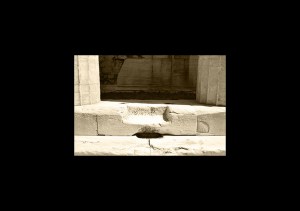
Stills from performance lecture:


Related reading:
The Construction of Southern Ruins, or Instructions for Dealing with Debt
Aristide Antonas, 2017

In addition, Luce Choules invited Professor Laurent Olivier to be part of the discussion following the presentation.
Bio:
Professor Laurent Olivier is general Curator at the National Museum of Archaeology in Saint-Germain-en-Laye (France). He completed his Ph.D at the University of Cambridge (UK). His research interests include history and theory of the archaeological discipline, as well as the archaeology of the contemporary Past. He is the author of The Dark Abyss of Time: Archaeology and Memory.
Reference:
“The field of archaeology continues to face a major crisis of interpretation. The traditional view is that the basic business of archaeology is to reconstruct the history of cultures and civilizations through their material productions. Olivier challenges this view with a new approach to archaeological remains based on the works of French theorists such as Foucault, de Certeaux, and Derrida, with insight from Darwin and Freud. His thesis is that archaeology does not study the past itself but rather what materially remains of the past in our present. Olivier also develops an interpretation of material culture based on Aby Warburg’s and Walter Benjamin’s work in the anthropology of art. With wider implications for history and all social sciences, The Dark Abyss of Time is a major contribution to the theory of time, memory, heritage, and archaeology. This flawless translation makes Olivier’s elegantly written work available in English for the first time.“
 Luce Choules